Bring up the target
Integrate and configure the kernel, board support package, device drivers and required system services for your target hardware.
ESL OS / Embedded Linux
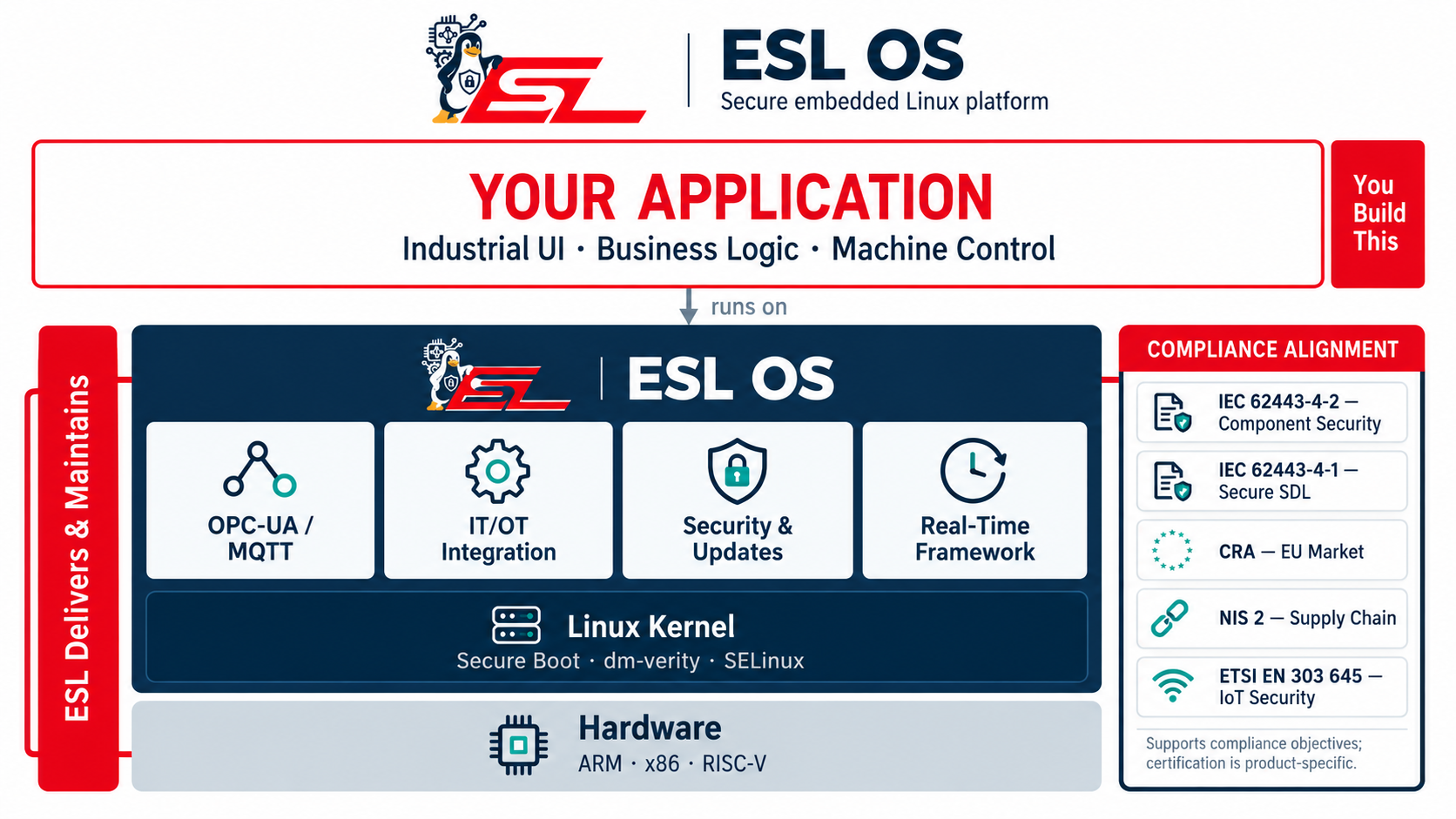
ESL OS brings board support, operating-system integration and product software together in a platform shaped for your hardware, use case and engineering team.
Discuss your platform
One platform, shaped to fit
Every embedded product has different hardware, operating constraints and lifecycle needs. ESL works across the software stack to establish a dependable Linux foundation and connect it to the product experience.
Integrate and configure the kernel, board support package, device drivers and required system services for your target hardware.
Organize repeatable builds, target testing and debugging around the tools, languages and delivery practices that fit your team.
Integrate the application layer, tune system resources and plan validation, maintenance and update needs for the product lifecycle.
Align on hardware, product functions, performance targets and lifecycle requirements.
Bring together the OS, BSP, drivers, services and product software, then iterate on target.
Test system behavior, address issues and prepare a maintainable release for the intended deployment.
Planning an embedded Linux product or platform refresh?
Talk with ESLESL OS / Secure lifecycle
Security work is part of the ESL OS delivery loop, not a final release check. Maintain component visibility, assess relevant vulnerabilities, apply and verify fixes, then carry validated changes through controlled production deployment.
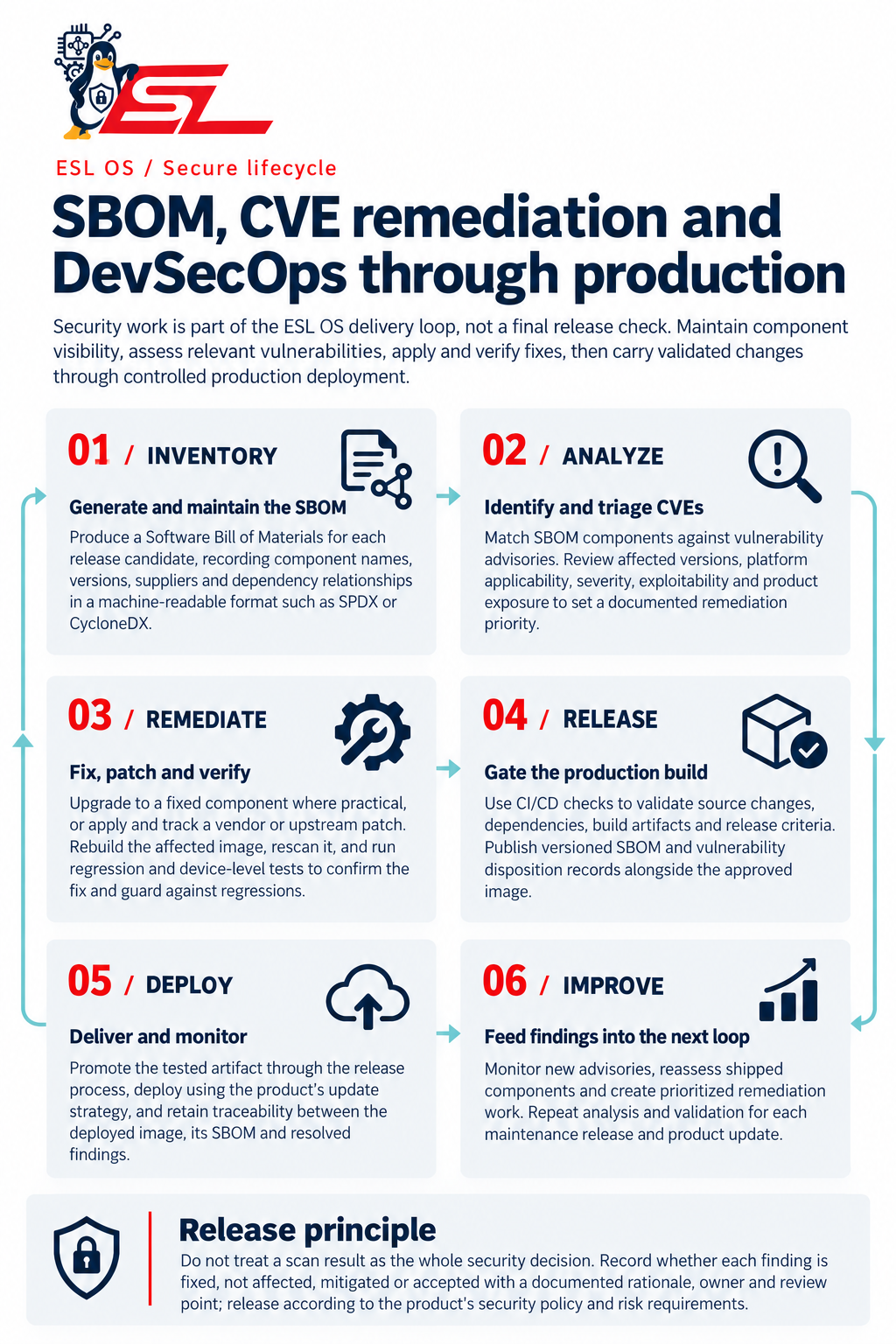
Produce a Software Bill of Materials for each release candidate, recording component names, versions, suppliers and dependency relationships in a machine-readable format such as SPDX or CycloneDX.
Match SBOM components against vulnerability advisories. Review affected versions, platform applicability, severity, exploitability and product exposure to set a documented remediation priority.
Upgrade to a fixed component where practical, or apply and track a vendor or upstream patch. Rebuild the affected image, rescan it, and run regression and device-level tests to confirm the fix and guard against regressions.
Use CI/CD checks to validate source changes, dependencies, build artifacts and release criteria. Publish versioned SBOM and vulnerability disposition records alongside the approved image.
Promote the tested artifact through the release process, deploy using the product’s update strategy, and retain traceability between the deployed image, its SBOM and resolved findings.
Monitor new advisories, reassess shipped components and create prioritized remediation work. Repeat analysis and validation for each maintenance release and product update.
Do not treat a scan result as the whole security decision. Record whether each finding is fixed, not affected, mitigated or accepted with a documented rationale, owner and review point; release according to the product’s security policy and risk requirements.
Why ESL OS?
Linux products need more than a distribution choice. ESL OS brings security planning, component visibility, vulnerability handling and update engineering into the platform work from the start, with scope and evidence shaped around your hardware, product risks and support plan.
Plan component inventories, SBOM records, vulnerability handling, coordinated disclosure and a defined update lifecycle around applicable Cyber Resilience Act requirements. ESL can help prepare engineering evidence; the product manufacturer remains responsible for determining applicability and demonstrating compliance.
Use secure-development practices informed by IEC 62443-4-1 and component-security considerations from IEC 62443-4-2. Where product requirements and hardware support call for them, scope and validate controls such as secure boot, access control, encrypted storage and audit logging. Applicable standards and regulatory obligations, including ETSI EN 303 645 or NIS 2, depend on the product and organization; ESL engineering support does not itself constitute certification.
Define BSP, kernel, driver and vulnerability-response ownership against the product’s intended support life. For deterministic workloads, integrate real-time Linux capabilities where appropriate and measure timing on the target; results and maintenance periods depend on hardware, upstream support, project scope and validation.
Bring OS integration, SBOM and CVE workflows, release checks and update planning into a clear project scope. A maintained platform foundation can reduce repeated in-house integration effort; deliverables, ongoing responsibilities, schedule and commercial terms are agreed for each engagement.
Develop and maintain an embedded Linux platform for supported SoCs and custom boards. Potential targets include NXP i.MX8, TI AM62x, Intel Atom and Rockchip RK3568; support is confirmed through hardware, BSP and lifecycle scoping.
Design an update path around signed artifacts, integrity verification, atomic installation, delta delivery where practical, and rollback or recovery appropriate to the device. The approach is selected and validated for the product’s boot, storage and connectivity architecture.
Integrate vision, machine-learning and predictive-maintenance applications on the same maintained OS foundation, subject to the target processor, accelerator, memory and software-stack capabilities.
ESL OS / Platform coverage
These processor families are common in connected industrial products and can be evaluated as ESL OS targets. Platform, board and software support are confirmed for each project; long-term security maintenance and regulatory evidence depend on the product scope and lifecycle plan.








ESL OS platform examples illustrate processor families that may be evaluated for embedded products. A processor listing does not imply a pre-certified or currently maintained ESL OS image; exact SoC, board, BSP and lifecycle support are confirmed during scoping. CRA applicability and IEC 62443 evidence are assessed for the product and its intended use.